
China steps up as the world’s sober big brother
Yields on Chinese government bonds have exhibited stability amid heightened market volatility, mirroring China’s evolving role in the global order.
Global uncertainty has remained elevated throughout the past year, largely due to shifting US policies on trade and diplomacy. Chinese markets have exhibited relative resilience through it all, a marked improvement from market reaction on tit-for-tat tariff increases just a year ago.
Despite being the main target of US President Donald Trump’s tariff and word wars, Beijing has managed to stabilise bond yields and maintain a stock market rally through consumption stimulus programs and a push towards high-tech manufacturing, along with a pledge to relax its hold on the private sector. In 2025, Chinese equities hit multiple record-highs amid much excitement over artificial intelligence (AI) systems, overshadowing initial nervousness over global trade disruptions. China continues to tread this path of stability in 2026, and we expect the world’s second-largest economy to ride out the current global oil crisis with ease.
Narrow range for bond yields
Over the past year, Chinese government-issued bonds traded steadily despite the highly volatile global environment. Graph 1 illustrates the divergent directions of yields on 10-year Treasuries issued by the US, which had seen a sharp rise beginning March 2026, against a relative downtrend for Chinese bond yields. It is worth noting that Chinese 10-year bonds saw yields move within a narrow range of 1.6-1.9 per cent during the period against a wider spread of 4-4.6 per cent for US debt notes.

Also, yields on Chinese notes were higher in the second half of 2025 which may be attributed to an increase in local government issuances that sent bond prices down (and therefore, yields went up). Uncertainty regarding China-US trade due to sky-high tariffs, as well as the continuing property sector crisis and deflation problem onshore, have also clouded market sentiment towards China bonds at the time.
Sentiment turned towards China’s favour in early 2026, though tempered by Beijing’s announcement of a softer GDP growth outlook for the year. The about-turn in the direction of bond yields occurred in March as a direct reaction to US’ initial attacks on Iran and the resulting global oil supply shock: yields fell as demand for Chinese bonds rose, while returns on US Treasuries rose amid increased volatility.
Exposure to Chinese debt papers also allow for diversification, given its unique positioning in the global market. These assets are likewise benefiting from ongoing capital flight away from the US and into high-growth developing economies, a trend we see sustained in the near term.
China’s position of strength
China emerged with a position of strength as the US-Iran conflict unfolded: the country now relies less on oil from the Middle East compared to its peers, runs on a more diverse energy mix, and maintains substantial reserves onshore. Graph 2 shows that as of 2023, nearly one-fifth of China’s oil imports come from Russia – with flows uninterrupted by sanctions imposed by the US and EU on Moscow since 2022 – followed by Saudi Arabia, Malaysia, and Iraq. Often, countries in East Asia and Southeast Asia mostly depend on the UAE, Saudi Arabia, Kuwait, and even the US for their supply.

China and Russia share a border, which makes crude oil transport much simpler and cheaper. Add the fact that China relies heavily on coal at 60 per cent of its energy mix, with oil only a far second at 18 per cent in 2023 plus a fast-rising renewable energy capacity. This setup gives the Middle Kingdom greater flexibility to mitigate oil price shocks and any resulting second-round effects. Further, China maintains the largest oil stockpile globally, which means that the country can draw from existing inventory during emergency situations.
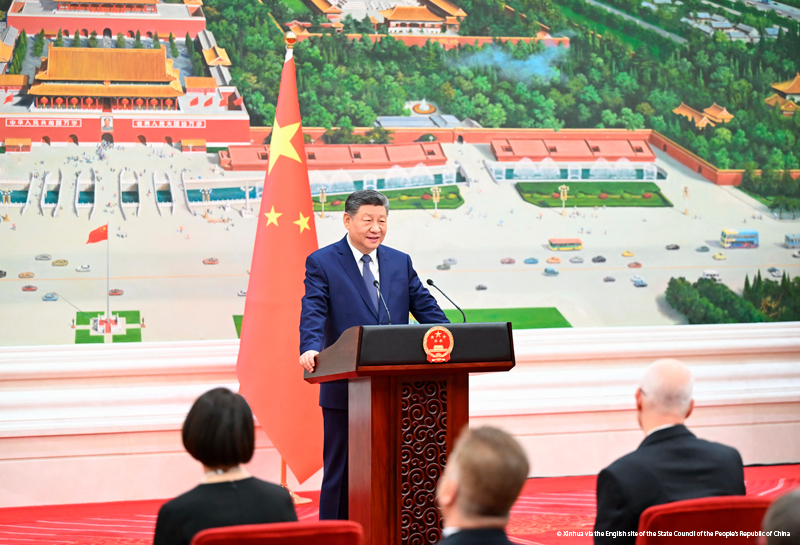
Beyond stability of supply, China also draws some form of geopolitical ascendancy from this position of abundance: it appeared to act as the sober and mature mediator between Washington and Tehran, as confirmed by a 6 May meeting between Iran and China’s foreign ministers and President Xi Jinping’s subsequent hosting of Trump in Beijing from 13-15 May.
It is evident that China has more to gain from greater global trade volumes, and we see that this is the country’s biggest interest in assuming the peacemaker role. Doing so also gives China some leverage among its peers.
The situation at the Strait of Hormuz remains fragile despite reports of a truce between US and Iran in late May, but it is still progress especially if it means that trade routes at sea are reopened. Of course, we expect China to capitalise on its increasing prominence as a diplomatic superpower to further its economic agenda, particularly to push its dominance in global manufacturing and international trade. One simply cannot avoid China, and this also applies to how we view portfolio allocations. We advise investors to take well-considered positions in Chinese assets to participate in Beijing’s growing role in international affairs, which we see will complement good returns drawn from recovering domestic demand and bustling exports.