
Indonesia charts course for its maritime sector
Indonesia aims to transform its maritime sector into a sustainable and growing blue economy that can attract foreign investments, enhance food security, and increase export competitiveness.
In 2025, Indonesia’s maritime sector contributed around 7 per cent of national output. If we are to look at Indonesia’s Blue Economy Roadmap, that number is expected to grow to 12.5 per cent of GDP by 2045. Meanwhile, the upcoming Ocean Impact Summit in October hopes to attract global investment into the country’s maritime and fisheries sectors.
However, doubts loom over whether Indonesia’s aspiration for the sectors can deliver economic development. In particular, there is a growing disparity in the implementation of the Blue Economy Roadmap wherein it could risk sidelining coastal communities in favour of the elite class. Not only that, the country’s maritime sector also faces logistical challenges – such as container shortages, rising freight costs, and worsening sedimentation at major ports – that threaten the competitiveness of the largest economy in Southeast Asia.
Marine productivity
One rising sub-sector is fisheries, supported by the increase in the domestic demand and consumption of protein-rich food. According to the Ministry of Marine Affairs and Fisheries, fisheries production in the first quarter of 2026 is expected to reach 3.6 million tons, indicating that the sub-sector is becoming the prime mover for the country’s food security and supply stability. However, an increase in production alone does not ensure long-term prosperity. Without proper regulation, marine resources will eventually dwindle.
With Indonesia’s more-than-17,500 islands, one of the main issues is illegal, unreported, and unregulated (IUU) fishing that has led to massive economic losses of over USD 800 million between 2020-2025 while threatening resource sustainability. Recognizing these threats, the government has granted the fisheries ministry an additional budget of IDR 2 trillion (USD 112 million) to curb IUU within Indonesia’s maritime areas. Despite the limited resources available, this shows the government’s efforts to mitigate severe loss of fisheries revenues as well as to protect the economic welfare of local fishermen depending on Indonesian waters for their livelihood. To achieve the latter, the Indonesian government launched the Fishing Village program to help build at least 1,000 villages to support two million fishers by the end of 2026 while also improving domestic maritime infrastructure and market access. Already, the allotted IDR 1.34 trillion (USD 75.18 million) for phase one has expanded by IDR 859 billion (USD 48.19 million) in phase two.
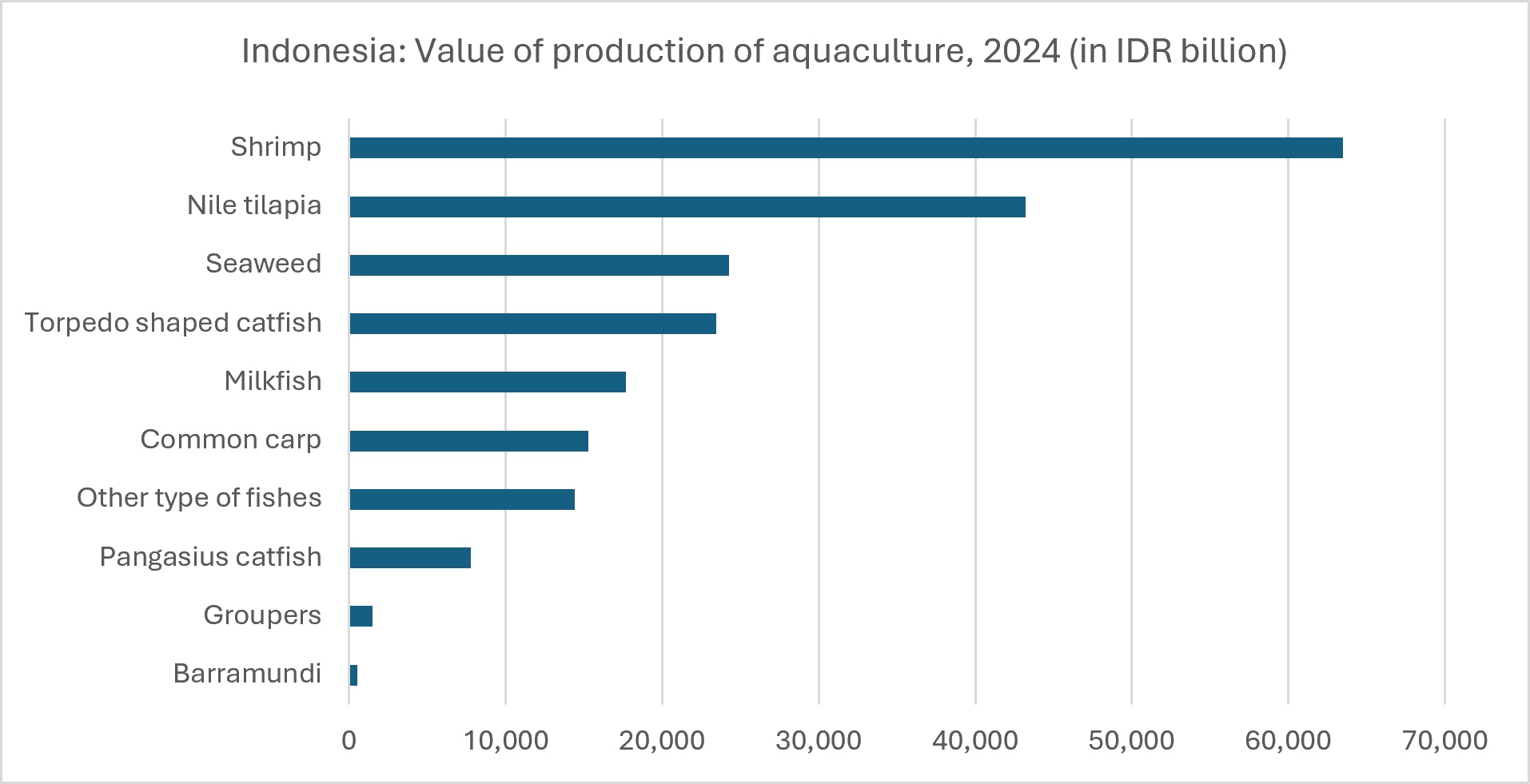
The Indonesian government is also expanding its seafood exports to other countries to boost foreign exchange earnings. Looking at Graph 1, the value of shrimp production stood at IDR 63.48 trillion (USD 3.56 billion) in 2024, which could make Indonesia the leading shrimp producer across the globe. Second to shrimp is tilapia which, according to the Maritime Affairs and Fisheries Ministry, has received high demand from US and Europe consumers. Indonesia could also capitalise on the rising global demand for fish produce.
Crisis to opportunities
Indonesia’s fisheries exports has gained significance for revenue generation given the scale of its aquaculture products penetrating the global market. However, the nation’s ambition as a leading exporter of seafood products may be short-lived due to the current geopolitical crises and global economic conditions.
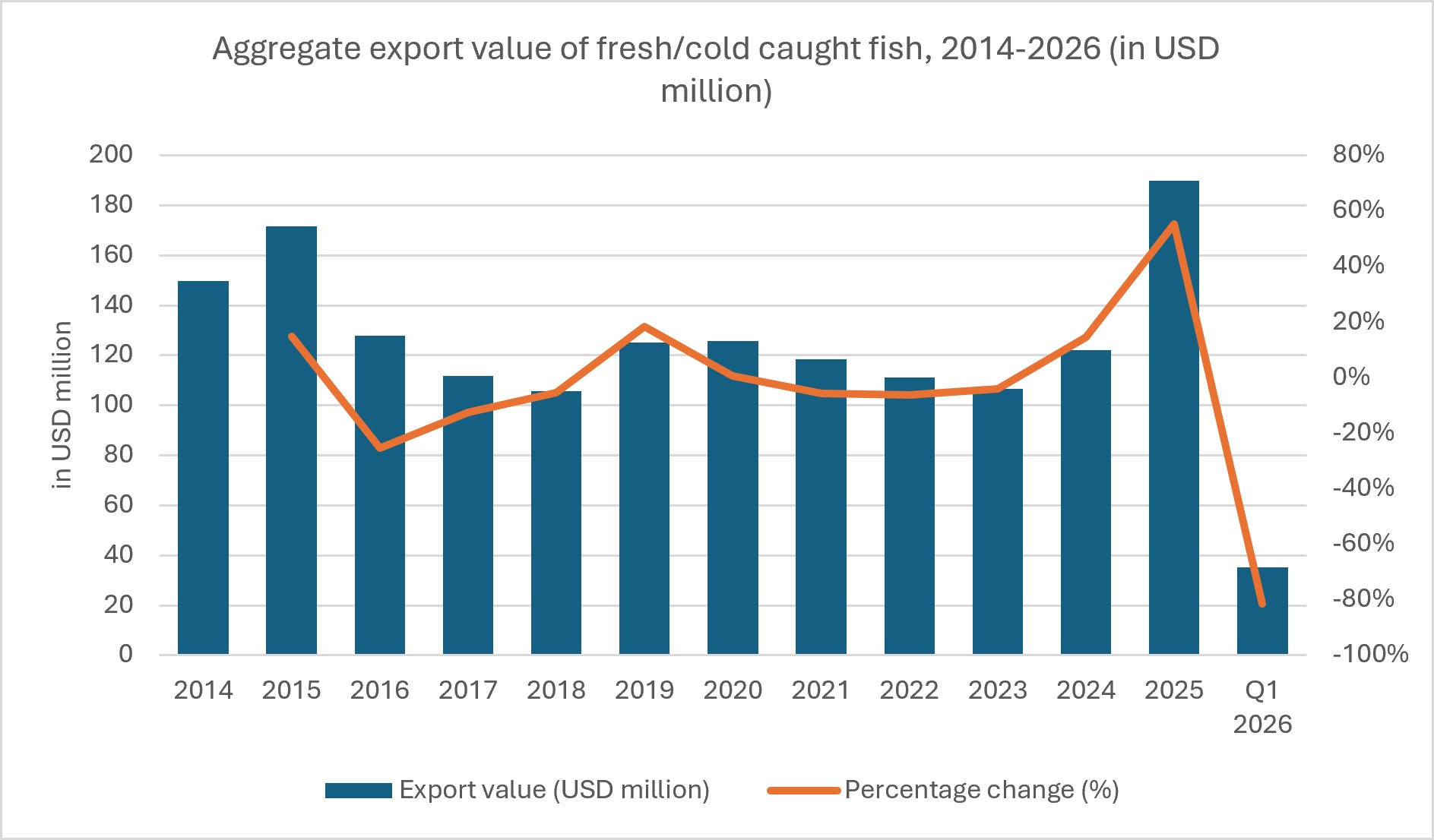
First, the initially proposed US tariffs in 2025 has affected shrimp shipments which had dropped by 30 per cent, resulting in one million workers laid off and the export market shifting towards China. Second, disruptions in the global supply chain due to the US-Iran conflict has made countries like Indonesia bear the surging costs on logistics and deal with limited container space, as ship turnaround times have become unpredictable. As such, latest export volumes have declined by 41.35 per cent from last year’s numbers.
In 2025, exports of fresh or cold-caught fish spiked by 50 per cent compared to the previous year to reach USD 189.9 million, as seen in Graph 2. This has contributed to Indonesia’s seafood exports that year, which totalled USD 6.27 billion, with international sales expected to further strengthen this year. Additionally, the Indonesian government has secured an approval for new fish export facilities in China, which expands access to export even more fish products to the Middle Kingdom. Currently, Indonesia sells 1,080 types of marine products to China.
Beyond the sea
Although there are still some challenges that Indonesia needs to overcome to improve its seafood industrial production, the potential is there. If the government wants to become a leader in the sector, it needs to invest in cold-chain facilities. While logistics efficiency is needed, cold storage facilities play an important role in maintaining the quality of products for the long term.
If the country’s seafood industry can capitalise on its potential, positive spillovers could reach the halal industry. Last year, Indonesia deepened its position in the global halal market, currently valued at USD 3 trillion, to attract foreign Muslim markets in trading seafood products and ensure supply chain integrity. This work was done in collaboration with Chinese regulators regarding food safety standards. For one, Indonesia is eyeing opportunities in the Saudi Arabian market for pilgrims with their own halal certificates.
Beyond the production of maritime resources, the Indonesian government hopes that, with the improvements on factors like logistics and certifications, the country’s blue economy can swim with the big fishes in the market and attract foreign investors.
This original article has been produced in-house for Lundgreen’s Investor Insights by on-the-ground contributors of the region. The insight provided is informed with accurate data from reliable sources and has gone through various processes to ensure that the information upholds the integrity and values of the Lundgreen’s brand.