

India’s big AI play
India is positioning itself as Asia’s hub for artificial intelligence systems, which may sound ironic given its labour surplus and the potential job displacements that may occur.
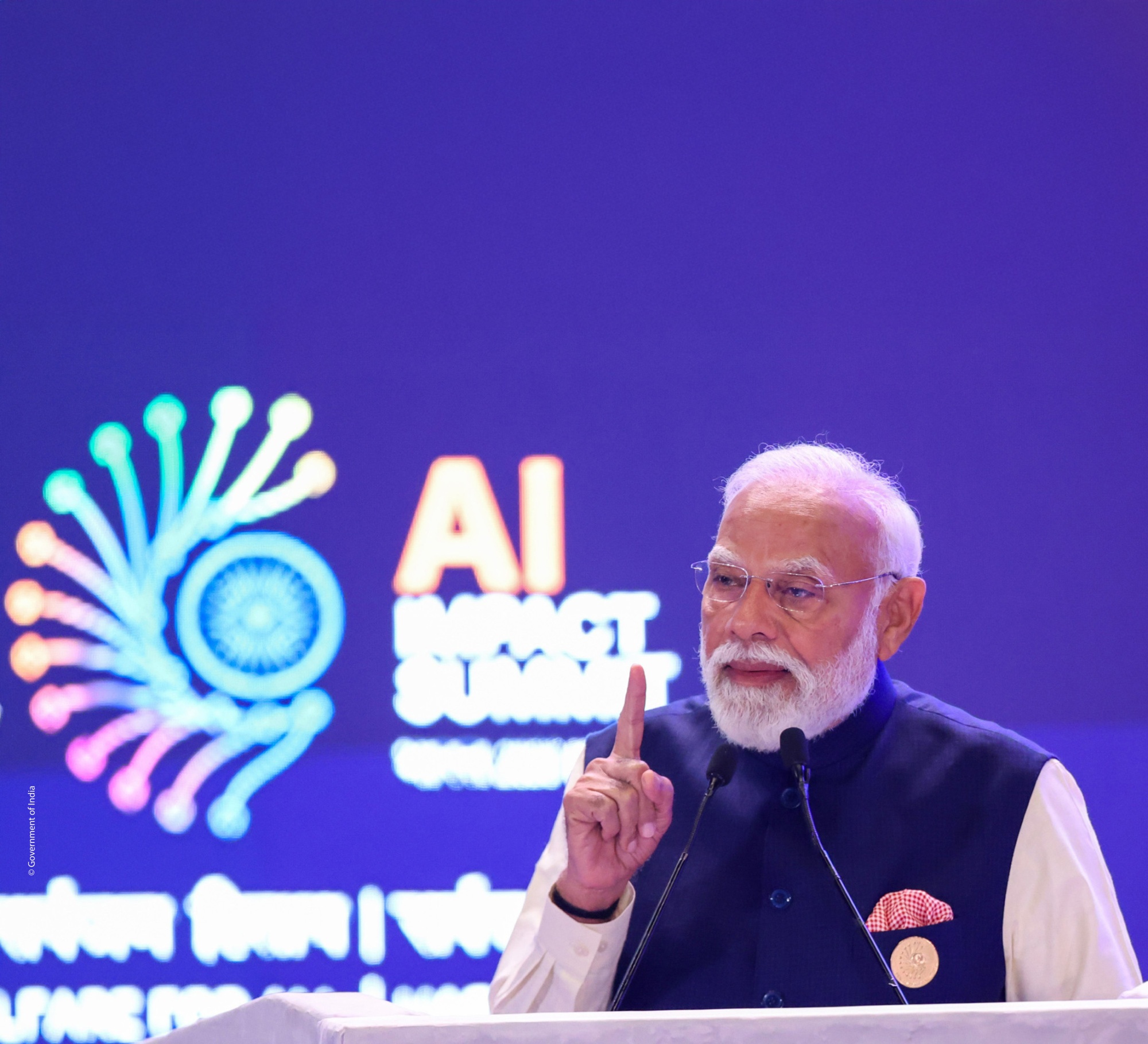
The Indian government has set bold goals to orchestrate rapid economic growth through artificial intelligence (AI). The world’s most populous nation hosted an AI Impact Summit from 19-20 February in New Delhi to send a strong message: India is ready to host AI ecosystems for global players.
It has set its eyes on building data centres, developing a domestic AI value chain, and training a new generation of software engineers and chip manufacturers to become agile users of sophisticated AI systems. These goals are bold and require a lot of catching up as companies in the US and China have had a headstart.
Advancing India
Prime Minister Narendra Modi is banking on the IndiaAI mission to unlock rapid growth in the domestic technology sector. With a five-year investment of INR 103.72 billion (USD 1.1 billion) until 2030, the government hopes to add USD 500 billion to India’s GDP through wider, more sophisticated AI usage across industries. The February summit quickly racked up investment pledges for India, with committed funding for AI infrastructure hitting USD 200 billion.
New Delhi is aggressively offering incentives to lure in foreign capital, dangling up to 20-year tax breaks for cloud services hyperscalers like Google Cloud and Amazon Web Services to take up base in the country. Local policies also seek to encourage semiconductor design and production.
India has made some progress in its push towards tech investments, with the sector beating the level of foreign equity inflows into the services sector for the first time in years. Graph 1 captures the surge in foreign direct investments into the computer software and hardware segment in April-December 2025 – already exceeding levels seen in previous years. This shows the significant potential of the tech sector to drive growth alongside logistics and business outsourcing, the latter having been the key pillar of India’s economy for decades. A rapid shift is happening; the focus now is on how to sustain this momentum and translate it into inclusive growth.

Despite the global excitement and a state-fuelled gusto towards AI, domestic demand for AI solutions remains muted. India has a lot of catching up to do in pushing generative AI adoption as it currently lags regional peers with a diffusion rate of 15.7 per cent as of end-2025. This is much slower than in Malaysia (19.7 per cent), the Philippines (18.3 per cent), and China (16.3 per cent) based on Microsoft’s AI Diffusion Report 2025. The constraints are fundamental, with the mismatch in labour skills and training the biggest factor.
Widespread AI adoption in developed economies is led by corporate workers employing chatbots and machine learning solutions to fulfil day-to-day tasks, but India’s job market is structured differently. The informal sector accounts for roughly 45 per cent of GDP, which might make AI adoption more challenging – or, at the very least, usage data may be harder to measure.
Further, labour data from the National Institution for Transforming India capture a structural shift in India’s job market: the computer and information services segment, which pays better than other domestic industries, saw employment tripling to 7.2 million within a 12-year period. However, this only represents barely 4 per cent of jobs within the services sector. More than a third are employed under Trade and Repair services – a segment with a much lower value-added teeming with informal employment arrangements.
Data centres on the rise
Part of India’s AI agenda is to be the home of Asia’s data centres, which are essentially powerhouses of cloud computing and AI systems servicing global users. Global technology firms scouting for locations for data centres can capitalise on India’s relatively affordable construction sector and its abundant supply of labour. Countries that topped Microsoft’s AI Diffusion list had been early in investing on digital infrastructure, allowing them to be ahead of the pack as tech sandboxes. Graph 2 clearly shows that India has some catching up to do here, which sounds challenging given that it has fewer resources to spare compared to mature economies.

Further, job and skills mismatch persist, making it difficult for jobseekers to land AI jobs. Opportunities within tech-related segments generally pay better than jobs in other industries, so it makes a lot of sense to push people into this sector. Although job postings in India are well above pre-pandemic levels, a survey revealed that 58 per cent of employers receive few applications largely due to a talent gap. AI-related employment is on the rise, but Indian jobseekers are less agile in upskilling to meet job descriptions.
Beyond ushering in new infrastructure supporting AI systems, the Indian government should also take steps to equip its labour force with the right skill sets to meet the demands of this high-growth sector. Shifting labour away from low-value-adding jobs towards tech and AI-related sectors bodes well for the larger economy, as it would mean higher incomes and greater productivity overall. Similarly, there is a need to support AI literacy for the larger workforce, mainly on how to use AI tools to streamline workflows, so that they become agile and more employable. In response, part of the IndiaAI mission is the provision of trainings to upskill IT professionals to be more AI-ready.
India faces tough competition in its quest to be Asia’s data centre hub, with Thailand and Indonesia among peers seeking the same status. The South Asian nation is ahead in terms of existing data centres, but it needs to do more to sustain the momentum and further get ahead.